The latest change to my portfolio has been to dump The TJX Companies (TJX) for a few reasons. To begin with the retail industry has been performing terribly these past few months with same store sales being relatively flat. TJX's growth is suppose to come from its European expansion, especially for the HomeGoods brand, but with Russian sanctions and poor exchange rates as seen affecting other company earnings I'm not optimistic. Also I bought TJX with the impression that it could be a stable grower but after more research I found the retail sector to be too competitive and unpredictable. I made the mistake of focusing only on the individual company performance and not the industry as a whole.
On the opposite side I more than doubled down on my Rite-Aid (RAD) position when it was at $6 which helped bring down my cost basis. With the remodels, McKesson distribution deal, and health management acquisitions there is a lot of potential that has yet to be realized.
Finally, now that it makes up a considerable percentage of my portfolio I've included my cash position with my holdings. I have a shopping list of stocks but at these valuations everything is too expensive so I plan on holding a sizable chunk in cash in preparation for any sell-offs toward the end of the year.
Monday, August 18, 2014
Monday, August 11, 2014
Stock Research: APC
Anadarko Petroleum Corporation (APC) is another oil exploration company that attracted my interest because they have contracts with ENSCO and Rowan for ultra deepwater drillships and are still considered a growth company.
 Oil production is split between US and International for 2014 but if you compare with last year's numbers it's interesting to see US production alone went from 96 to 146 million barrels of oil per day (MBOPD) versus International growth of 62 to 92 MBOPD. Further almost all capital investment for 2014 is allocated to the lower 48 states with large chucks dedicated to expanding the profitable Wattenberg field in Colorado and Delaware basin/Eagleford fields in Texas where wells counts have doubled since last year.

Capital expenditure paints the picture of where you get the most bang for your buck and right now that's in the US. The bulk of the capital will be used to expand operations in the Rockies and Texas so I'll be paying attention to their success in those regions. Considering Anadarko is only a few points off it's 52 week high I won't be buying any stock unless it drops low enough to justify the higher P/E and recent lackluster ROA/ROE track record. At the moment I don't see any advantage Anadarko has over their competition so I'm not willing to pay up for it.

Sunday, August 10, 2014
Stock Research: EOG
With offshore drillers in a state of softness from the over supply of rigs and reduced number of contracts I need to bring in a different type of sub-industry to my group of energy stocks. EOG Resources (EOG) is one company I started researching because they have a large presence in all of the major US oil fields, primarily the Eagle Ford shale.

Financially EOG is in a good position with low debt, cash on hand, and enough of a backlog in good wells that they can be picky in operating only the most profitable drill sites. They have some international exposure with sites in the Caribbean and United Kingdom which will keep them diversified from the core US locations. Operationally they are primarily an onshore producer using horizontal fracking techniques to extract oil.
What I like about EOG is they are large enough to provide stable earnings but are still a growth company. The dividend is currently at 0.62 and they have a market cap of 59 billion so they are not monolithic yet. While researching other oil companies I found almost all of them started a stake in the US because it's much easier/profitable to extract oil using modern fracking techniques than the more expensive deep water drilling or drilling in unstable regions. Until something changes to cause oil production in the US to cost more then offshore drilling I think EOG would be a good investment. Just a few years ago I remember everyone was drilling in the Gulf of Mexico, then natural gas production exploded in the US, and now crude production is what's hot.
Financially EOG is in a good position with low debt, cash on hand, and enough of a backlog in good wells that they can be picky in operating only the most profitable drill sites. They have some international exposure with sites in the Caribbean and United Kingdom which will keep them diversified from the core US locations. Operationally they are primarily an onshore producer using horizontal fracking techniques to extract oil.
What I like about EOG is they are large enough to provide stable earnings but are still a growth company. The dividend is currently at 0.62 and they have a market cap of 59 billion so they are not monolithic yet. While researching other oil companies I found almost all of them started a stake in the US because it's much easier/profitable to extract oil using modern fracking techniques than the more expensive deep water drilling or drilling in unstable regions. Until something changes to cause oil production in the US to cost more then offshore drilling I think EOG would be a good investment. Just a few years ago I remember everyone was drilling in the Gulf of Mexico, then natural gas production exploded in the US, and now crude production is what's hot.
Saturday, July 26, 2014
Book Club: One Up On Wall Street
One Up On Wall Street by Peter Lynch is a fantastic read that I would recommend to anyone that finds the stock market exciting. The book is completely opposite from The Intelligent Investor because Lynch is more interested in high growth stocks and is willing to pay up for it. He stresses investing in companies that others are overlooking and his favorites are when a company has a boring name, low number of analyst covering the stock, and it operates in a niche or as a monopoly.
 Instead of looking for only value stocks with a low P/B, Lynch categorizes stocks into different classes and evaluates them on a series of characteristics. Slow Growth are your dividend stocks that should show a continued history of dividend growth and a low payout ratio. Stalwarts have a history of steady predictable value growth. Cyclicals are your consumer goods that maintain low inventory and operate in a monopoly. Fast Growers have EPS growth rates above 20% and proven expansion plans and Turnarounds show low debt with increasing revenue.
Lynch's techniques are how I found Rollins (ROL) and Church & Dwight (CHD). When I was reviewing stocks on my screener I just randomly clicked companies that had the most boring names I could find and lo-and-behold I came across these two companies. One operates a worldwide pest extermination monopoly and another owns niche brands with household recognition and both have company names that give no indication of that.
Instead of looking for only value stocks with a low P/B, Lynch categorizes stocks into different classes and evaluates them on a series of characteristics. Slow Growth are your dividend stocks that should show a continued history of dividend growth and a low payout ratio. Stalwarts have a history of steady predictable value growth. Cyclicals are your consumer goods that maintain low inventory and operate in a monopoly. Fast Growers have EPS growth rates above 20% and proven expansion plans and Turnarounds show low debt with increasing revenue.Lynch's techniques are how I found Rollins (ROL) and Church & Dwight (CHD). When I was reviewing stocks on my screener I just randomly clicked companies that had the most boring names I could find and lo-and-behold I came across these two companies. One operates a worldwide pest extermination monopoly and another owns niche brands with household recognition and both have company names that give no indication of that.
Quarterly Update: CNI
Canadian National Railway (CNI) reported high single to multi digit growth for Q2 as it recovered quickly from the abnormally cold winter weather that caused a slowdown across the industry. With 35% growth, grain snapped back the largest with enough orders to contribute to future quarter earnings. While coal and steel were flat, oil and frac sand picked up the slack in the energy shipments.
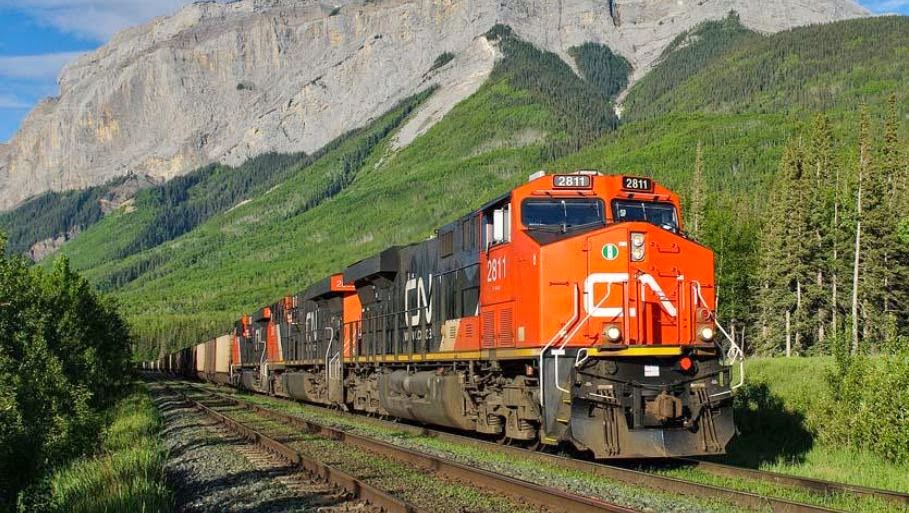
I'm happy to see the oil boom in the US is providing a great replacement for an industry that has a large dependence on shipping coal. Coal is on a rapid decline as government policies are restricting new power plants and utilities are transitioning away from coal and into renewables. CNI is seeing the potential for more block trains (a term used to describe when an entire trains is commissioned for one type of cargo) of heavy crude and frac sand to and from large oil drilling sites.
CNI is in my portfolio as a stalwart to balance my high growth tech stocks and it is doing a fantastic job in filling that role. On a pull back I may consider dumping my position in TJX and rolling it over to more CNI.
I'm happy to see the oil boom in the US is providing a great replacement for an industry that has a large dependence on shipping coal. Coal is on a rapid decline as government policies are restricting new power plants and utilities are transitioning away from coal and into renewables. CNI is seeing the potential for more block trains (a term used to describe when an entire trains is commissioned for one type of cargo) of heavy crude and frac sand to and from large oil drilling sites.
CNI is in my portfolio as a stalwart to balance my high growth tech stocks and it is doing a fantastic job in filling that role. On a pull back I may consider dumping my position in TJX and rolling it over to more CNI.
Saturday, June 28, 2014
Stock Research: DPZ
 I researched Domino's Pizza (DPZ) because it shares the same qualities that led me to purchase shares in Starbucks. They have a focused brand/product line and embrace technology. Way back when Domino's started the turnaround I was amazed by the online experience in ordering pizza. While I never liked the pizza I was sold on the self-deprecating commercials enough to try it again.
Domino's has good growth momentum. They have expanded overseas in almost all emerging markets while staying aligned with their domestic philosophy to deliver pizza fast. In contrast I found Yum's international plan to promote Pizza Hut as premium dinning experience short-sided. I understand the international desire for Western products allow companies to charge a premium, but paints the brand as a fad that could fall out of favor as new Western trends are adopted.
In addition, in most international countries everything is driven by mobile accessibility. With Domino's superior mobile applications and extensive online order capabilities it is better positioned to become ingrained in the populations daily lives. I find the scenario of young adults ordering pizzas on their phones better for growth than a family's special night out at a Pizza Hut sit-down restaurant. If you look at the trends in technology, online order systems like GrubHub and Eat24 are exploding in popularity (according to the 2013 annual report over 40% of orders in Q4 were digital). Domino's is essentially a restaurant with its own custom GrubHub service and with the expansion into other non-pizza offerings this could be a vertically integrated dinning experience.
Domino's is profitable with growing revenue, earnings per share, and good operating margins but here's the bad. They have a large amount of debt compared to assets. $1.5 billion in long term debt compared to $500 million in assets but the upside is they are still generating free cash flow and have refinanced that debt until 2019. Buying into Domino's is buying into the success of their international expansion and ability to take enough market share from competitors to grow revenue at least 3x in the next 5 years.
Stock Research: AAWW
As fuel becomes the primary cost for airlines and worldwide delivery services expand it's always a good idea to look at the air freight business. Atlas Air Worldwide Holdings (AAWW) is a company that takes the capital expenditure hit by purchasing aircrafts and leasing them out to air cargo companies. Atlas Air gets a consistent income stream and airlines get the flexibility to add/reduce capacity.
When it comes to aircraft leasing there are two specializations. One is cargo aircrafts where Atlas Air operates in and the other is passenger aircrafts through companies such as Fly Leasing. While the customer base is larger for passenger aircrafts the turnover is greater because airlines always want the most fuel efficient planes available. This means higher capital expenses and the ROI would not be as great since the aircrafts become outdated quicker than cargo planes.
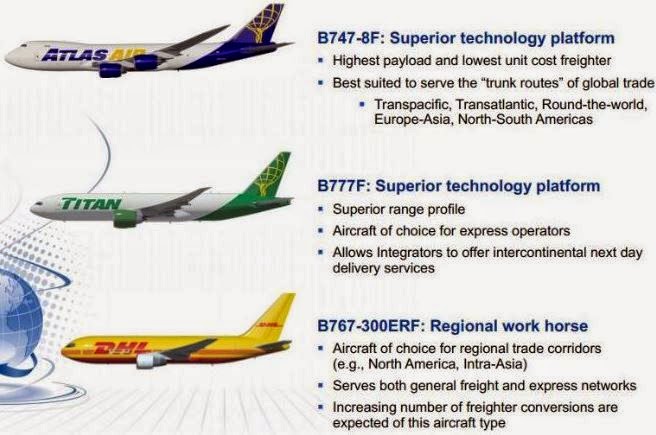 Further, businesses can specialize in a particular type of leasing. Wet leasing is a lease that includes the aircraft, crew, maintenance, and insurance (ACMI) while dry leasing is just the aircraft itself. For most of Atlas's history it has been a wet lease operator but is starting to expand its dry leasing operations with six new 777 freighters in order to mitigate reduced demand for ACMI contracts. This is a good strategy if only to expand its customer base and gain more presence, especially since there is large demand for dry leasing.
I like the simplified operations of Atlas. For one they only own Boeing aircrafts which makes maintenance and crew training cost efficient and they have identified three aircraft body styles that are suitable for all their needs while retiring the one-off models. Financially Atlas Air is undervalued. It has a P/B value of 0.7 and a P/E of 10 with healthy operating margins and consistent EPS. The only downside is there is no growth catalyst for the company or in the industry right now.
When it comes to aircraft leasing there are two specializations. One is cargo aircrafts where Atlas Air operates in and the other is passenger aircrafts through companies such as Fly Leasing. While the customer base is larger for passenger aircrafts the turnover is greater because airlines always want the most fuel efficient planes available. This means higher capital expenses and the ROI would not be as great since the aircrafts become outdated quicker than cargo planes.
I like the simplified operations of Atlas. For one they only own Boeing aircrafts which makes maintenance and crew training cost efficient and they have identified three aircraft body styles that are suitable for all their needs while retiring the one-off models. Financially Atlas Air is undervalued. It has a P/B value of 0.7 and a P/E of 10 with healthy operating margins and consistent EPS. The only downside is there is no growth catalyst for the company or in the industry right now.
Subscribe to:
Posts (Atom)