Saturday, July 26, 2014

Book Club: One Up On Wall Street

One Up On Wall Street by Peter Lynch is a fantastic read that I would recommend to anyone that finds the stock market exciting. The book is completely opposite from The Intelligent Investor because Lynch is more interested in high growth stocks and is willing to pay up for it. He stresses investing in companies that others are overlooking and his favorites are when a company has a boring name, low number of analyst covering the stock, and it operates in a niche or as a monopoly.

Instead of looking for only value stocks with a low P/B, Lynch categorizes stocks into different classes and evaluates them on a series of characteristics. Slow Growth are your dividend stocks that should show a continued history of dividend growth and a low payout ratio. Stalwarts have a history of steady predictable value growth. Cyclicals are your consumer goods that maintain low inventory and operate in a monopoly. Fast Growers have EPS growth rates above 20% and proven expansion plans and Turnarounds show low debt with increasing revenue.

Lynch's techniques are how I found Rollins (ROL) and Church & Dwight (CHD). When I was reviewing stocks on my screener I just randomly clicked companies that had the most boring names I could find and lo-and-behold I came across these two companies. One operates a worldwide pest extermination monopoly and another owns niche brands with household recognition and both have company names that give no indication of that.

Quarterly Update: CNI

Canadian National Railway (CNI) reported high single to multi digit growth for Q2 as it recovered quickly from the abnormally cold winter weather that caused a slowdown across the industry. With 35% growth, grain snapped back the largest with enough orders to contribute to future quarter earnings. While coal and steel were flat, oil and frac sand picked up the slack in the energy shipments.


I'm happy to see the oil boom in the US is providing a great replacement for an industry that has a large dependence on shipping coal. Coal is on a rapid decline as government policies are restricting new power plants and utilities are transitioning away from coal and into renewables. CNI is seeing the potential for more block trains (a term used to describe when an entire trains is commissioned for one type of cargo) of heavy crude and frac sand to and from large oil drilling sites.

CNI is in my portfolio as a stalwart to balance my high growth tech stocks and it is doing a fantastic job in filling that role. On a pull back I may consider dumping my position in TJX and rolling it over to more CNI.

Saturday, June 28, 2014

Stock Research: DPZ

I researched Domino's Pizza (DPZ) because it shares the same qualities that led me to purchase shares in Starbucks. They have a focused brand/product line and embrace technology. Way back when Domino's started the turnaround I was amazed by the online experience in ordering pizza. While I never liked the pizza I was sold on the self-deprecating commercials enough to try it again.

Domino's has good growth momentum. They have expanded overseas in almost all emerging markets while staying aligned with their domestic philosophy to deliver pizza fast. In contrast I found Yum's international plan to promote Pizza Hut as premium dinning experience short-sided. I understand the international desire for Western products allow companies to charge a premium, but paints the brand as a fad that could fall out of favor as new Western trends are adopted.

In addition, in most international countries everything is driven by mobile accessibility. With Domino's superior mobile applications and extensive online order capabilities it is better positioned to become ingrained in the populations daily lives. I find the scenario of young adults ordering pizzas on their phones better for growth than a family's special night out at a Pizza Hut sit-down restaurant. If you look at the trends in technology, online order systems like GrubHub and Eat24 are exploding in popularity (according to the 2013 annual report over 40% of orders in Q4 were digital). Domino's is essentially a restaurant with its own custom GrubHub service and with the expansion into other non-pizza offerings this could be a vertically integrated dinning experience.

Domino's is profitable with growing revenue, earnings per share, and good operating margins but here's the bad. They have a large amount of debt compared to assets. $1.5 billion in long term debt compared to $500 million in assets but the upside is they are still generating free cash flow and have refinanced that debt until 2019. Buying into Domino's is buying into the success of their international expansion and ability to take enough market share from competitors to grow revenue at least 3x in the next 5 years.

Stock Research: AAWW

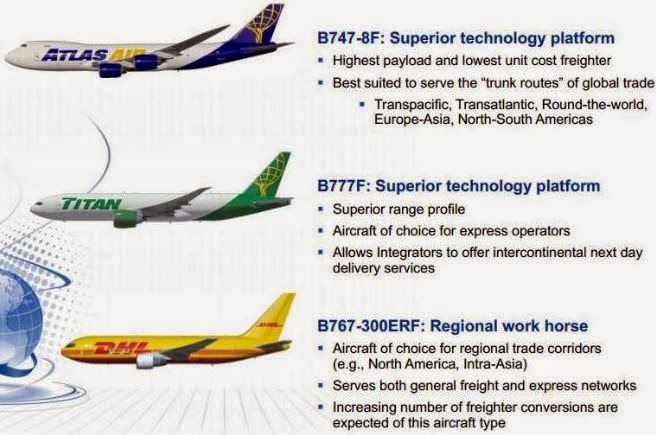
As fuel becomes the primary cost for airlines and worldwide delivery services expand it's always a good idea to look at the air freight business. Atlas Air Worldwide Holdings (AAWW) is a company that takes the capital expenditure hit by purchasing aircrafts and leasing them out to air cargo companies. Atlas Air gets a consistent income stream and airlines get the flexibility to add/reduce capacity.

When it comes to aircraft leasing there are two specializations. One is cargo aircrafts where Atlas Air operates in and the other is passenger aircrafts through companies such as Fly Leasing. While the customer base is larger for passenger aircrafts the turnover is greater because airlines always want the most fuel efficient planes available. This means higher capital expenses and the ROI would not be as great since the aircrafts become outdated quicker than cargo planes.

Further, businesses can specialize in a particular type of leasing. Wet leasing is a lease that includes the aircraft, crew, maintenance, and insurance (ACMI) while dry leasing is just the aircraft itself. For most of Atlas's history it has been a wet lease operator but is starting to expand its dry leasing operations with six new 777 freighters in order to mitigate reduced demand for ACMI contracts. This is a good strategy if only to expand its customer base and gain more presence, especially since there is large demand for dry leasing.

I like the simplified operations of Atlas. For one they only own Boeing aircrafts which makes maintenance and crew training cost efficient and they have identified three aircraft body styles that are suitable for all their needs while retiring the one-off models. Financially Atlas Air is undervalued. It has a P/B value of 0.7 and a P/E of 10 with healthy operating margins and consistent EPS. The only downside is there is no growth catalyst for the company or in the industry right now.

Tuesday, June 17, 2014

Book Club: Common Stocks and Uncommon Profits

Common Stocks and Uncommon Profits by Philip A. Fisher was the second investment book I read that Warren Buffet endorses. Instead of listing a series of formulas and metrics that should be researched to gauge a stocks worth he pays attention to the characteristics of the business. What products they make, how efficient management is doing, what is the public's perception of the company? This book is great at getting you to think of the mental questions you should be asking yourself when picking a stock.

My main takeaway is the concept of scuttlebutt (or water-cooler talk). Usually the advice goes that when someone gives you a stock tip there is a high chance that stock is already overvalued and ripe for a pull back. I see it more as a mood gauge for the overall market and can avoid hot sectors or monitor for short term positions on major pull back days. I also like to take note of popular companies and revisit them after the crazy has died down. This is why I started watching Mad Money and reading articles on Seeking Alpha daily.

Parsley Energy (PE) and Rite Aid (RAD) are two speculative stocks I picked up using this logic. Right now there is a gold rush for natural gas in US shale and everyone is throwing money at the large companies like Pioneer and EOG. Instead of buying into companies with years of growth priced in I chose the small Parsley Energy that operates in the same region and could grow or be acquired. Rite Aid was purchased because it's a popular turnaround play that dropped significantly from reduced guidance that chased away unrealistic investors expecting a price pop. If it regains irrational price momentum then I would benefit heavily but if not I still purchased at a discount and can benefit from the company's intended turnaround plan.

Sunday, June 15, 2014

Stock Research: CRM

Salesforce.com (CRM) is a product I'm very familiar with considering it's being used in companies I've worked for. While traditional software developers hate the "no software" sand boxed ideology I can see the huge upsides for companies that aren't "in the software" business but want to have a customized platform. Salesforce is a proper cloud solution because it's not just a virtual server you buy time on like AWS or Azure that still requires a huge development team. I would best compare it to a Blogger or Wordpress website. Sure you can write all the fancy php/javascript code to develop an amazing web experience but in some situations a template solution works just as well but saves thousands of dollars.

Reading over Salesforce's latest fiscal results it's exciting to see the large revenue growth but what's more interesting is the expenses. Salesforce grossed close to 950 million in profits and spent 990 million in operating expenses in the last quarter but 65% of it's expenses were in marketing and sales. Salesforce is still a young company and is wisely spending money to grab as many customers as it can and get them embedded into their proprietary ecosystem. Right now the focus is brand awareness and making customers feel confident in their product. If you remove marketing cost, Salesforce is actually profitable.

I'm a buyer of Salesforce for two reasons. One is the freeing of company data from in-house networks. At one point in time business was conducted on paper, something that you could take anywhere. Then computers came about and chained employees to a desk; however, with the explosion of smartphones/tablets and ubiquitous internet connectivity work can once again be conducted out of the office but the resources/cost needed to securely deliver this experience is out of reach for most companies to do themselves. Second is the continued abstraction of software. At one time developing software meant writing assembly code to modify bits on a computer. Then we moved to higher level natural language syntax and in the future software development can be as simple as drag and drop. Salesforce is just another iteration of this evolution. For the foreseeable future there will always be "software" companies like Microsoft/Salesforce who develop the tools but for any company whose business is not to sell software there really is no need to have a large development team.

Friday, June 13, 2014

Book Club: The Intelligent Investor

The Intelligent Investor by Benjamin Graham is considered the Bible of value investing and if you Google top investing books this one appears on almost every list. It's a long read at over 400 pages but it gives a good foundation to any individual investor. The first half explains the basics of how the stock market works and what expectations you should have when investing. The second half focuses on applying Graham's philosophy to securities analysis.

It's amazing how Graham's methods were derived almost half a century ago but most of his predictions were correct and direct parallels over what he saw during the Great Depression occurred during the tech bubble. Graham goes for reliable growth over long time scales so you'll never pick multi-baggers or hear about your stocks in the news.

My takeaways are to look for stocks that are undervalued (ie having a low Price to Book value) and show consistent growth over a number of years. Investing with Graham's methods would have you avoid high growth (high P/E) stocks like Yelp in exchange for slow growers like Caterpillar. I could only imagine what he'd think of Amazon.

Ensco (ESV) and  Rowan (RDC) are two stocks I picked using Graham's methods. At the time Ensco had a P/B of 0.93 (below 1 is what you're looking for) and a P/E of 8.33 and Rowan had a P/B of 0.79 and a P/E of 15.32 (below 20 is preferable). These stocks have actually turned out to be very profitable in the short time I've held them and I'm only now starting to hear them mentioned in the news.